|
|
What
went wrong
|
|
31-Aug-11
|
|
|
|
The
incident described in
the following article
from 2000 attests to the critical
importance of student
pilots, pilots,
instructors and
passengers being acutely
aware of (and
understanding why) they
MUST NOT unfasten safety
harnesses in gliders
while in the air
... |
|
|
|
|
| WHAT
WENT
WRONG |
| FLIGHT
SAFETY
AUSTRALIA,
MAY-JUNE
2000 |
| |
|
|
| The
man who fell to earth |
 |
| |
|
|
| Geoff
Osborne |
| |
|
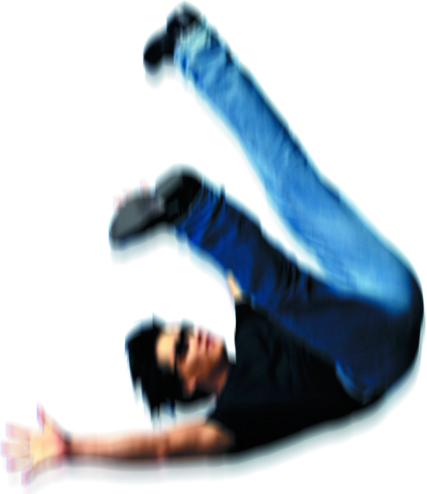
It
was like a scene from a
B-grade Hollywood comedy:
a glider pilot finds
himself lying
face-down on a perspex
canopy wondering if it
will stop him falling
thousands of feet to the
earth below. It doesn’t |
|
|
|
|
|
|
|
IT WAS the first day in ages that offered any real
potential for soaring. Thermal activity was strong
and I had little trouble reaching 3,500ft on my
first climb in the single-seat Cirrus. |
|
The aim of this flight was to fine tune a recently
purchased Balsak computer speed director, which
requires minor in-flight adjustments after
installation via half a dozen tiny trim pots
located at the base of the unit. |
|
I began my tests, accelerating to 100kt, gently
raising the nose and closely watching the result
on the instrument. The wide spacing between the
thermals made the task easy. After four or five
tests I was getting a little low, so I found a
thermal and – while climbing in the lift –
made an adjustment to the trim pot on the
instrument using a small fine-blade screw
driver. |
|
As we approached the top of the thermal at
4,500ft, the screwdriver slipped from my fingers,
fell to the floor and rolled back under the front
part of the seat, just out of reach. I began to
run through the possible problems the loose
screwdriver may cause. I knew that just behind a
small bulkhead, under the seat, were the elevator
and aileron control rods. As long as the wayward
tool remained in the bottom of the aircraft, in
front of the small bulkhead there would be no
problem. |
|
If, however, the screwdriver made it to the other
side of the bulkhead, it could easily become
lodged in any number of open fittings and bearings
and could cause the elevator or
aileron to become jammed. I started the descent,
heading back toward the airfield, five kilometres
away. |
| |
|
"
I shot upward and
ended up
with my face
pressed hard
against the thin perspex
canopy. For a second
or two it held,
then exploded
with a huge bang sending
sharp jagged triangles
of plastic flying in
all directions.
" |
|
|
|
|
|
|
|
At 3,000ft cruising at 50kt I hit a rough patch of
turbulence and the aircraft zoomed, then fell.
Below the seat the screwdriver clanked, then after
another dip I heard a metallic clang which I could
feel through the control column. It must have
passed through one of the holes in the bulkhead. I
gave the controls a wiggle, and felt no
obstruction. Reassured, I decided all was well.
But then I began to think about the possibility of
turbulence while on final: if the controls jammed
I wouldn’t have the height to recover. |
|
Loosening the shoulder harness I lent forward and
reached under the seat. I could feel the
screwdriver with the tips of my fingers but couldn’t
stretch far enough to grab it. I loosened the seat
harness as far as it would go and unlocked the
rudder pedals sliding them all the way forward. I
then slid as far forward in the seat as I could
go. The screwdriver was still beyond my grasp. I
would just have to chance the landing. |
|
At 2,700ft I ran into a turbulent thermal, and the
screwdriver was once again clanging below the
seat. I could feel the slight impact through the
control stick. Images passed through my mind of
the Cirrus stalling or spiraling in, completely
out of control on short final. I had to get that
screwdriver. |
|
A few careful turns in the thermal and I was soon
back at 3,000ft. I set the heading for a large
blue hole, thinking there would be less turbulence
out there. With the harness loosened I leveled the
wings, set the trim for 45kt and slid forward
again. Reaching under the seat with my right hand,
I managed to slip it through the bulkhead. |
|
The
screwdriver
now
lay
in
the
bottom
of
the
fuselage
well
out
of
reach.
I
slid
back
in
the
seat
to
plan
my
next
move.
Opening
the
airbrakes
and
lowering
the
nose
I
could
hear
the
screwdriver
slide
forward
as
the
aircraft
decelerated,
then
a
“thunk”
as
it
hit
the
back
of
the
forward
bulkhead
and
stopped.
I
was
hoping
this
would
place
it
within
reach.
I
slid
forward
again
and,
holding
myself
in
place
with
the
pressure
of
my
legs,
I
gained
access
through
a
hole
and
managed
to
touch
the
driver
with
the
back
of
my
hand
–
but
from
my
position
it
was
impossible
to
pick
it
up. Adding
to
the
problem
was
the
size
of
the
access
hole,
making
it
impossible
to
rotate
my
hand
and
grasp
the
little
sucker. |
|
I simply couldn’t slide forward enough to grasp
the screwdriver while wearing the harness. So
checking the area, I headed for a large blue patch
about five kilometres wide directly in front. |
| |
|
Hit
by a strong thermal:
Undoing the harness completely
I slid all the way forward. This allowed
me free access to the bulkhead and I could
now rotate my hand about 90 degrees as it
entered the hole. After fumbling a little, my
fingers managed to trap the
loose screw driver against
the back of the bulkhead as I quickly worked
my fingers till I had it in my grasp, mission
accomplished. |
|
Arching a little in the confines of the cockpit
and supporting myself on one elbow I retrieved one
side of the harness. Leaning the other way I
easily retrieved the other half. With both the
lower parts of the harness now in my grasp I
wiggled in the seat, at the same time pulling both
ends free, preparing to snap them into the locking
mechanism. |
| |
|
|
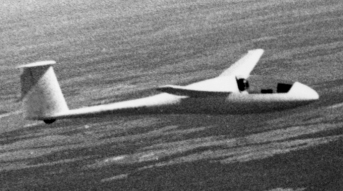
| Hands
on the controls:
The Cirrus is quite marginal in
terms of pitch stability and has an all-moving
tailplane which is powerful in effect and very
sensitive at high speeds. Two good reasons for
leaving at least one hand firmly planted on the
controls at all times. |
|
|
|
| |
|
Suddenly the glider hit a strong thermal hidden in
the blue sky and the left wing rose rapidly. At
the same time the nose swung to the right and
dropped, placing me in negative-g. Fortunately I
was holding the end of the harness straps
together, and this stopped me from being thrown
out. As I attempted to slide the ends into the
snap clasp, the glider continued accelerating with
the nose down at about 30 degrees, with a slow
roll to the right. The negative-g increased along
with the speed. It required a great effort to hold
on to the two ends of the harness – the only
thing preventing me from being thrown against the
perspex canopy. I managed to slide my left
leg out from under the instrument panel and place
my heel on the other side of the control stick. I
was travelling well over 140kt and still in
negative-g but the pressure required to hold on
was easing noticeably. I felt that I was beginning
to get the aircraft under control again. I tried
to put more pressure on the stick, but my foot
suddenly slipped from behind the stick. The trim
control took over again, the stick shot forward,
and the glider was suddenly in a 20- degree nose
down attitude with about 60 degrees of right bank.
The nose suddenly dove past the vertical, and the
aircraft rolled upside down. |
|
The sudden increase in negative-g finally broke my
hold on the harness. I shot upward and ended up
with my face pressed hard against the thin perspex
canopy. For a second or two, it held, then seemed
to explode with a huge bang sending sharp jagged
triangles of plastic flying in all directions. I
became a projectile. |
|
All I could see were blurred coloured streaks, of
green, brown and blue. It took a moment before I
realised my loss of sight was caused by the speed
I was now travelling. |
|
I seemed to be on my back, looking up at the
blurred blue streaks. But what height was I at? I
started at 3,000ft, minus the time spent on the
initial dive, plus the time spent on the second
descent. Two and a half thousand feet seemed a
good guess, minus the time spent laying against
the canopy, and the distance I’d already fallen.
Somewhere between 2,200 and 1,100ft I
guessed. Did I have a parachute? I was going to
leave it behind – I normally only use it as
ballast – but I did bring it. |
|
Five seconds passed. It was time to pull the cord.
In my mind I was looking at the parachute as
though I was standing in front of it studying it.
I could see the “D” ring tucked in its pouch
on the right side. I found myself looking at my
right side – it wasn’t there. I suddenly
realised it was on the left. My right hand darted
across my chest and pulled the “D” ring. |
| A
green flash raced past my right side moving at
high speed – the pilot chute, instantly followed
by a long green streamer as the main canopy raced
out of the pack after it. An almighty “FRUMP”
and suddenly I was decelerating from 120kt-plus,
to something more moderate as the large 28ft
canopy deployed. |
| |
| Crippled
aircraft:
|
|
Directly above the parachute, like a moon peering
out from behind a cloud, the inverted glider
appeared – large and close. I watched closely as
the crippled aircraft circled off to the right. It
was descending at a faster rate than me and its
orbit appeared to be centred on me. |
|
A glider with a grudge! I watched it slowly circle
toward me approaching from the left, just 20
metres away and slightly above. The approach angle
began to look threatening. I grabbed a handful of
lines at the rear of the chute, pulled them down
to my waist, hoping this would steer me inside the
glider’s turn. I watched closely as it passed a
few metres below my feet then collided with the
ground, breaking the left wing in two, and
snapping the rear of the fuselage at the base of
the fin, sending up a small cloud of dust. |
|
Suddenly I realised I was only a few feet off the
ground. This was my first parachute jump, so I
flexed my legs, bending them at the knees in
preparation for the hard impact of the
landing. |
|
I
found myself standing upright on the ground – no
impact, no sliding along. I remember wondering
whether I should do a roll or something. A trace
of blood was running down the outside of my nose.
My sunglasses must have cut me when they were
trapped between my face and the canopy. |
|
As I unclipped the parachute, I noticed that I
still had the screwdriver clutched tightly in my
hand.
It
took almost a month for the scarlet red marks on
my body left by the parachute harness to fade.
Several ground observers of the incident judged I
had deployed the parachute at about 800ft. |
| |
|

|
| Broken
hull:
VH-GOT
after
it
plummeted
3,000ft
to
the
ground
without
a
pilot.
After
an
extensive
rebuild,
the
aircraft
came
11th
in
the
nationals
later
that
year.
The
aircraft
is
still
flying
today. |
|
|
|
| |
| ANALYSIS
> Before a fall |
| |
| Maurie
Bradney & Mike Valentine |
|
Maurie Bradney is the Australian national gliding
coach. |
|
Mike Valentines is a CASA sport aviation
specialist. |
| |
|
IF YOU fly an aircraft in which it is normal to
wear a parachute (most single-seat gliders) and if
in fact you have a serviceable parachute with you, wear
it – don’t just use it as a cushion.
Geoff very nearly did just that, and he would have
paid the highest possible price had he not come to
his senses before take-off and strapped it on. It
was a recently repacked chute, so it opened
correctly and he got a complete canopy |
|
While it may be common practice to move around the
cabin of other aircraft unrestrained, it is very
unusual to do so in a glider. Gliders have a
four-point shoulder and lap harness and this is
expected to be worn at all times – so much so
that checking it is not even a part of the most
commonly used glider pre-landing check. |
|
While wearing a parachute on this flight was a bit
of an afterthought, I wonder if it was not a
factor in Geoff’s decision to undo the harness? |
|
When he realised that he could only reach the
screwdriver by undoing the harness, that would
have been a good time to sit back and reassess the
situation. Was it possible to reach the
screwdriver with the shoulder harness undone but
the waist harness secured loosely to allow greater
freedom of movement? It may have been possible to
recover the screwdriver without running any risk
of being ejected |
| |
| A
firm hand: |
|
Some gliders (for example, Blanik) are very stable
in pitch and can be trimmed to a speed and safely
left to their own devices, needing only a gentle
guiding hand on the stick, even in quite turbulent
air. The Cirrus, however, should have a firm hand
on the stick at all times. It is marginal in pitch
stability and has an all-moving tailplane which is
powerful in effect and very sensitive at high
speeds (say, over 80kt). |
|
Pilot induced oscillations (PIOs) were common in
Cirrus gliders and you still hear of the odd
occurrence even now. It seems to me that going
fishing in a Cirrus cockpit, and trusting the
glider to remain on an even keel in known
turbulent conditions, would have a reasonably
predictable outcome. |
|
Some people might say that Geoff should have
forgotten the screwdriver and focused on landing
safely. But if the controls had jammed, that
course of action could have proved disastrous,
especially if the controls jammed at low altitude. |
|
So
did he in fact do the right thing? No. Perhaps, on
learning that he could not reach the screwdriver
with the harness on, he should have considered a
controlled parachute jump from the aircraft. Would
this have been the best solution to this problem?
Well, no. After Geoff dropped the screwdriver he
said he “began to run through the possible
problems the loose screwdriver may cause”. |
|
|
|
"
While it may be common
practice to move around
the cabin of other
aircraft unrestrained, it
is very unusual to undo
your harness in a glider.
" |
|
|
|
|
|
|
|
With hindsight it’s easy to suggest the perfect
solution to every aviation problem. And in this
case the perfect solution would have been early
identification of the design flaw in this
particular aircraft that allows loose objects to
interfere with the elevator and aileron control
rods. |
|
If the problem had been identified before the
flight, a number of remedies could have been
considered. A short-term remedy would be to tie
one end of a piece of string around any object
which could potentially interfere with the
controls – pencil, screwdriver, and so on –
and the other end to the pilot’s wrist. Even
better, a guard could be installed over the
bulkhead holes to prevent objects getting through
to the exposed elevator and aileron control rods. |
|
|
|
What
would
you
have
done? |
|
Would you have removed your harness? Would you
have left the screwdriver on the floor and chanced
a landing? Would you have parachuted out of the
aircraft because of the possibility that the
controls might jam? |
|
If it had been me, I would have been reluctant to
trust the glider to keep me out of trouble while I
went fishing for the screwdriver. I would not have
been prepared to take my hand off the stick for
more than a second or so – nor would I have been
prepared to undo my harness. |
|
This means that my fishing expedition would have
had limited scope. I’m not saying my decision
would have been right, because you can’t argue
with Geoff ’s ultimate success, however bizarre
the circumstances. Maybe I would have experienced
jammed controls if I had followed my instincts and
maybe I would have been in deep trouble because of
it. The important thing is that Geoff is still
with us and that is a great outcome. |
| |
|
|
|
|
|
|
|
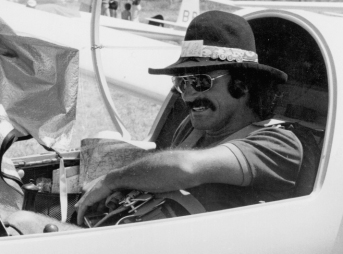
Ultimate
success:
Author Geoff Osborne three months after the
accident. These days he flies an Auster J1 and a Grunau
Baby II. |
|
|
|
|
|
|
|
|
|
|
|
|
"Mein
Gott" (VH-GOT) flew
at the Gliding
Queensland Easter
Competition held at
Chinchilla in 2009
(piloted by Stephen
O'Donnell and his son
Luke). Stephen finished
second in the Club Class
overall results.
|
|
|
|
>
Return
to Home Page
|
|
|
|
|
|
|
|
|