Ben
Stubbs indulges his Top Gun fantasies as he takes to
the skies for some emissions-free flying.
I
can hear nothing but the sound of my breath rattling
in and out within the cockpit. Silence is bad - it's
one of the few things I remember from our briefing.
"It's
your aircraft!" Maverick yells to me from the
front.
I'm
most certainly the Goose of this scenario, though
we're pilots wearing Glarefoils, not Aviators. I grab
the stick and yank it hard left. The Snowy Mountains
on the horizon become a vertical white stripe and my
stomach is rearranged by the G-forces as we take the
turn. We straighten up and I slip out of my momentary
Top Gun fantasy.
I'm
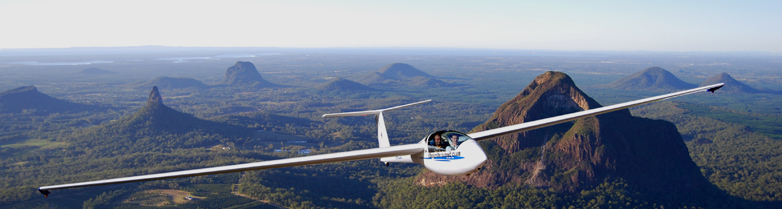
in a fibreglass glider above Cooma in the Snowy
Mountains experiencing "environmental
flying" on a crystal-clear winter morning. My
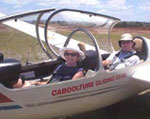
guide and flying partner is the chief flying
instructor of the Canberra Gliding Club, Drew McKinnie,
who I secretly think of as Maverick during the time
we're in the air chasing waves and thermals. While the
rest of the aviation world is focused on the
disruption caused by an ash cloud from a Chilean
volcano, we have the entire sky to ourselves in
southern NSW. We have no engine and our maximum speed
is about 100 knots (still, a respectable 185km/h), so
we aren't worried about the particles from the ash
cloud interfering with our glider flight.
Because
we have no propeller, we're towed into the air by an
old crop-duster, the Piper Pawnee, which drags us
through the yellow fields of Monaro with a red rope.
Then we're up and over a highway and flying. The
glider measures 15 metres from wing tip to wing tip,
so McKinnie is careful to check our clearance as we
wobble up into the air over gnarled gums and power
lines. The Piper banks and pulls us higher, towards
the cauliflower clouds. The altimeter spins to 1800
metres, which is 1000 metres above the plains from
where we set off.
McKinnie
yells at me as we climb, "Whatever you do, don't
touch the yellow button - or the red button." I
nod and he explains, "The yellow will release us
from the tow plane and the red opens the canopy!"
In
cross-country or competition flights, glider pilots
are fitted with parachutes, though there is no such
luxury for us today in our tandem exploration. I keep
my hands tucked up under my armpits as we continue to
rise above the farmland. The town of Cooma spreads out
below us and the cobalt scar of Lake Eucumbene sits
just beneath the mountains that are sparkling white on
the horizon. McKinnie counts down and presses the
yellow button. There is a loud "click" and
suddenly it feels like we're floating inside a
streamlined bath tub. The Piper veers left with a tail
of smoke behind it and we tip right, giving us an
unobstructed view of the coils of the Murrumbidgee
River.
We
go through the moves with our duplicate controls;
flying sideways using the rudders and stalling in the
air above the sea of gum trees while my co-pilot
points our nose up above the horizon to reduce speed.
My stomach is on spin cycle, though I relax a little
when McKinnie tells me he has been flying gliders
since 1970 and has lost count of how many thousand
flights he's taken.
He
is one of the elder statesmen of the gliding club
based in a paddock outside Cooma. It is a perfect
location for unassisted flying, I'm told,
"because of the incredible waves".
As
we drift towards the dry Bredbo hills, McKinnie
explains the phenomenon.
"Imagine
water flowing down a stream," he says, curving
his hand to illustrate the point. "As it goes
over the rocks it arcs up, creating a wave. Wind is
the same. As it blows off Mount Kosciuszko and hits
the foothills it creates the same sort of effect.
These are the waves we chase here."
The
conditions are so good for gliders on the Monaro
plains that the Canberra Gliding Club runs an
eight-day wave camp every September from its Bunyan
Airfield for enthusiasts to learn to fly. The high
altitude and hilly conditions here harness the wind
billowing off Australia's highest mountain range and
numerous records have been achieved as a result. The
gliders regularly fly above 6000 metres; local pilot
Rick Agnew achieved the Australian altitude record in
a glider when he reached 10,000 metres here in 1995.
McKinnie
instructs me to grab the stick and point us north. I
nudge the glider left, dipping us below the horizon
accidentally and we throttle through the air at speed.
My stomach groans with the increased pressure but
McKinnie maintains a calm voice as he tells me to find
the horizon again to keep us steady. We level out.
He
points out an odd sculpture protruding from the hill
below us, like a television antenna. This artwork is
known by locals as "Another Blue Poles", a
21-metre metallic structure of blue steel rods that
was built in 1978 as a response to the federal
government's purchase of the Jackson Pollock painting.
The
wind surges past us in the canopy and despite the
absence of a motor, it is still noisy as we slalom
between the thermals. McKinnie reminds me that when
it's quiet you know you're in trouble. "If
there's no wind, there's nothing to glide on," he
says matter-of-factly.
Part
of the appeal for McKinnie, whose father was in the
Royal Australian Air Force, is the strategy of the
sport. "It's like chess," he says. "You
have to think ahead to predict conditions when you
don't have an engine and porpoise between the
clouds."
McKinnie
pushes the stick down to demonstrate his control and
we surge ahead at 95 knots. "Gliding is a great
leveller," he says. "It's all about being
responsible. It's fun if you find a wave or a thermal
but you don't want to get carried away and have to
ring your wife to pick you up from South
Australia!"
A
handful of gliders are out today, drifting through the
clouds around us. They look like giant, silent eagles
scanning the tawny fields for prey.
I
watch the altimeter of the glider spin lower as we
circle the hills. The cars on the highway glint in the
sunshine and McKinnie indicates that we're turning in
for landing. Maverick takes control once again and I'm
happy to be Goose in the passenger seat.
It
feels like the final dip in a roller-coaster as we
descend and approach the landing strip. I can see the
walking trails on Hangar Hill only metres below us and
the flapping yellow windsock at the end of the runway.
The wheels skid on the grass and we coast towards the
hangar before coming to a stop.
McKinnie
presses the red button and releases the canopy. My
co-pilot pats me reassuringly - mission accomplished.
I stay seated for a moment in the cockpit,
appreciating the safe sound of silence.
Ben
Stubbs flew courtesy of the Canberra Gliding Club.
FAST
FACTS
Getting
there
The
Bunyan Airfield is 12 kilometres north of Cooma on the
western side of the Monaro Highway. From Sydney, it is
390 kilometres south, or about 4½ hours' drive. There
are regular flights to Cooma from Sydney with
Aeropelican.
Staying
there
Ellstanmor
is an 1875 manor house and bed and breakfast. Rooms
cost from $100 a night, including breakfast; see
ellstanmor.com.au.
Woodvale
is a restored three-bedroom cottage built in 1853,
with barbecue facilities and a spacious verandah.
Phone 0457 234 099; see woodvalecooma.com.au.
Flying
there
Trial
instructional flights with the Canberra Gliding Club
cost from $150 a session. The joy-flight option costs
from $120. A deluxe flight costs from $180.
The
Wave Camp will be on September 17-25. Phone the club
on 0428 523 994; see canberragliding.org.
More
information
There
are many spots across the state to enjoy
"environmental flying". To find one of 80
gliding clubs in Australia, see nswgliding.org.au. For
more on Cooma, see visitcooma.com.au.