|
Colditz
PoW Escape Glider |
|
12-Feb-12
|
|
|
|
| On
a snowy day in December, 1943, while he looked out over
the German town of Colditz, POW Bill Goldfinch noticed
snowflakes outside his window drifting upward. Perhaps it
would be possible, he thought, to escape from the prison
in a glider. The updraft would help in getting the glider
airborne. Also, there was an ideal area from which to
launch a glider: the castle's chapel roof, which was
hidden from the guards' watchful eyes. The prisoners could
use ropes, pulleys, and a counterweight to propel the
glider along the roof. |
Goldfinch
presented his idea to Dick Howe, head of 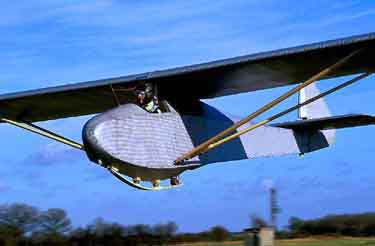 the
prison's escape committee, who approved it. Goldfinch's
friend, Jack Best, was also assigned to the project. Using
a textbook discovered in the prison library, Goldfinch and
Best, both engineers, worked out the specifications for a
glider. It would carry a pilot and one passenger. The
wings would have enough lift to carry the glider's
occupants over the town of Colditz -- more than 300 feet
below -- and across the River Mulde. Goldfinch then drew
up the plans. Goldfinch
and Best began building the glider in their rooms. This,
of course, could only be temporary since it would be
impossible to hide such a large project from the guards.
So in one of the castle's attics -- the one adjacent to
the roof slated for the runway -- prisoners created a
workshop. Using shutters and mud made from attic dust,
they constructed a false wall at one end of the attic,
giving the glider builders a small space that could
accommodate the largest of the disassembled glider pieces.
When they were finished, anyone who went into the main
part of the attic saw a convincing false wall at one end
and no indication that the attic was eight feet shorter
than before. To gain access to the shop, the prisoners
also built a trapdoor in the shop's floor. the
prison's escape committee, who approved it. Goldfinch's
friend, Jack Best, was also assigned to the project. Using
a textbook discovered in the prison library, Goldfinch and
Best, both engineers, worked out the specifications for a
glider. It would carry a pilot and one passenger. The
wings would have enough lift to carry the glider's
occupants over the town of Colditz -- more than 300 feet
below -- and across the River Mulde. Goldfinch then drew
up the plans. Goldfinch
and Best began building the glider in their rooms. This,
of course, could only be temporary since it would be
impossible to hide such a large project from the guards.
So in one of the castle's attics -- the one adjacent to
the roof slated for the runway -- prisoners created a
workshop. Using shutters and mud made from attic dust,
they constructed a false wall at one end of the attic,
giving the glider builders a small space that could
accommodate the largest of the disassembled glider pieces.
When they were finished, anyone who went into the main
part of the attic saw a convincing false wall at one end
and no indication that the attic was eight feet shorter
than before. To gain access to the shop, the prisoners
also built a trapdoor in the shop's floor. |
|
 The
materials needed to fashion the tools and glider were for
the most part scavenged. The prisoners made a plane from a
table knife, drills from nails, saw handles from bed
boards, and saw blades from both a wind-up record player's
spring
and the frame around iron window bars. For the glider's
control wires they appropriated electrical wire taken from
unused areas of the castle.
For
the wings spars and ribs they availed themselves of
floorboards and bed slats, respectively. And to cover the
glider's wooden frame they used bed sheets, which they
doped with hot millet (part of their rations) to stiffen
the fabric. They obtained a few items through bribery:
casein glue and a metal drill, for example. Constructing
the glider's parts was tedious, to say the least. For the
wings alone the builders had to craft over 6,000
hand-fashioned pieces. To make just one rib, they had to
shape a piece of wood, steam it to render it pliable, bend
and pin it, then finally glue it into place. And the
glider required hundreds of these. The
materials needed to fashion the tools and glider were for
the most part scavenged. The prisoners made a plane from a
table knife, drills from nails, saw handles from bed
boards, and saw blades from both a wind-up record player's
spring
and the frame around iron window bars. For the glider's
control wires they appropriated electrical wire taken from
unused areas of the castle.
For
the wings spars and ribs they availed themselves of
floorboards and bed slats, respectively. And to cover the
glider's wooden frame they used bed sheets, which they
doped with hot millet (part of their rations) to stiffen
the fabric. They obtained a few items through bribery:
casein glue and a metal drill, for example. Constructing
the glider's parts was tedious, to say the least. For the
wings alone the builders had to craft over 6,000
hand-fashioned pieces. To make just one rib, they had to
shape a piece of wood, steam it to render it pliable, bend
and pin it, then finally glue it into place. And the
glider required hundreds of these.
|
| Takeoff
was finally scheduled for the spring of 1945. The plan was
to assemble the aircraft, then catapult it off the
chapel's roof using a metal bathtub filled with concrete
as ballast. The tub would fall five stories. The glider
would then sail out silently over the town of Colditz,
giving its occupants a good head start over the German
guards, who would soon discover a bathtub in the yard and
two prisoners missing. |
|
But
alas, the launch never took place. The war was nearing its
end, and it was decided to postpone what would have been
the glider's brief and only flight. |
|
|
|
 |
|
|
|
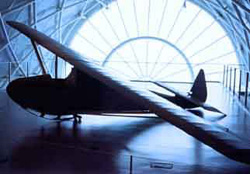
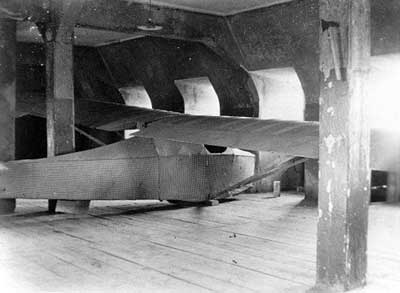
The
only known picture of the glider that was
assembled by Bill Goldfinch and Jack Best in the
lower attic of Colditz Castle above the chapel:
photo taken in April 1945 by an unknown American
GI. |
|
|
|
|
|
 |
|
|
|
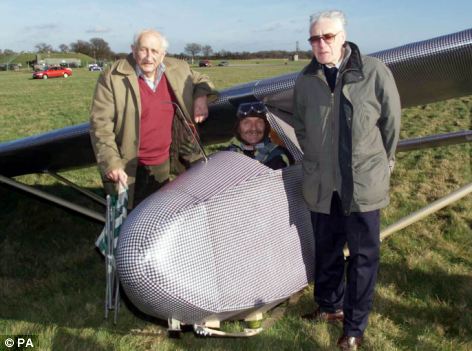
Jack Best
and Bill Goldfinch (both now deceased) with a replica of their
glider being flown at RAF Oldham in Hampshire by
piolot John Lee. |
|
|
|
|
 |
|
|
 |
|
|
|
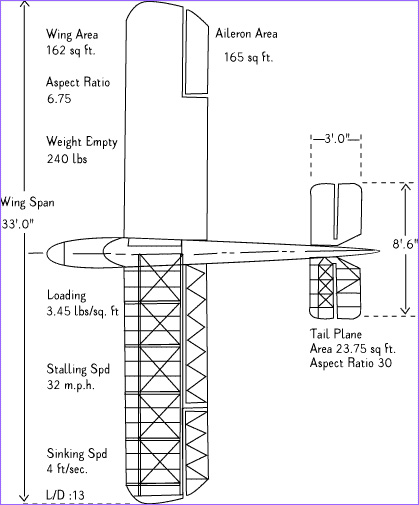
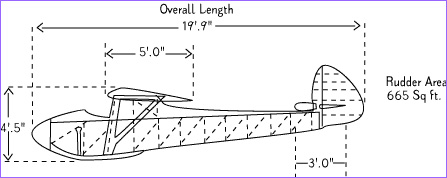
The above
information, photos and plans are from the website of Fiddlers
Green
(an aircraft paper model supplier that sells a model of
the Colditz escape glider). |
|
|
|
|
|
An
article by Emma Reynolds dated 09-Feb-12 in the UK's
MailOnline
reports
that another replica of the Colditz Cock is about to take
to the skies as part of a Channel 4 documentary. |
|
|
|
|
|
|
|
|
|