What
can glider pilots teach the airline industry?
Could
gliding be the low-cost training answer to keep
airline pilots’ manual flying skills fresh and
sharp? TIM
ROBINSON reports
from the recent RAeS International Flight Crew
Training Conference, held on 25-26 September.
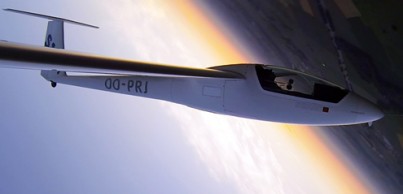
Could
gliders hold the key to improving airline
safety? (Stemme)
The
2013 RAeS
International Flight Crew Training Conference
this year was noteworthy for a number of
reasons; its highly international make-up (some
71 of 125 delegates were from outside the UK,
from 19 countries). Its focus: ‘Upset
Prevention, Recognition and Recovery Training’
was rated “the best and most productive
conference held anywhere on the work to prevent
aircraft loss of control in flight”.
A
key point agreed by many (if not all) speakers
and delegates at the conference was that in the
past 15 years, manual flying skills of airline
pilots has atrophied. Increased cockpit
automation, rigid standard operating procedures,
more use of flight simulators and a reduced pool
of military pilots has conspired to erode basic
flying skills in a new generation of pilots.
This, as AF447 and perhaps more recent
incidents, have shown, can result in hull losses
or be fatal in certain, rare circumstances. Loss
of control incidents (LOC-I) or ‘non-normal’
(eg high angle-of-attack or bank) situations are thus
a major safety issue.
Though
the conference detailed the high-level work
going on by airlines, training schools,
manufacturers, regulators and stakeholders,
including the Society’s own International
Committee for Aviation Training in Extended
Envelopes (ICATEE)
,an intriguing presentation from Captain Sarah
Kelman, a safety officer at easyJet,
highlighted a more simple solution to manual
flying skills erosion – gliding.
Jet
airliners and gliders
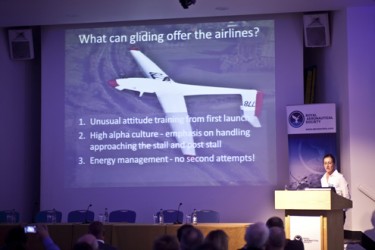
Capt
Sarah Kelman, easyJet (and British Gliding
Association) gives her presentation. (Lukas
Willcocks)
At
first glance, there may be little in common
between a glider weighing between 500-800kg and
the latest single-aisle jet airliners carrying
hundreds of passengers. One is powered, utilises
complex computers, has radar, flies higher,
faster and is heavier being made out of metals
(and composites). What does a professional
airline crew with the weighty responsibility of
the safety of their passengers have in common
with a two-place sport glider, flown for fun?
However,
Capt Kelman, an accomplished glider pilot
herself as well as an airline pilot, observed
that there were skills that she maintained in
her glider that are directly relevant to her day
job as an Airbus pilot and, which indeed,
enhance her situational awareness and ability to
deal with these non-normal, and recover quickly
from, upset situations.
She
said that already many commercial airline pilots
fly gliders already in their spare time, because
of the direct experience of flight and that
every flight is different and a challenge.
(Indeed the most famous example is Capt Chesley
‘Sully’ Sullenberger whose gliding
experience proved critical at the right time in
the Hudson River in 2009 - saving all 155 people
on board.)
Unusual
attitude is the norm
Capt
Kelman noted that gliding needs a number of
skills that may have application to the hi-tech
airline cockpit – especially when things go
wrong.
For
example, she pointed out that ‘unusual
attitudes’, which an airline pilot may be
fearful of getting into, are second nature for
the glider pilot. The glider pilot experiences
an “unusual attitude” from the first launch
as a 40deg winch launch (combined with a
semi-reclining seat) means the climb (at
3,000feet per minute) feels almost vertical. The
pilot also cannot see the horizon at this point.
The pilot is trained to fly by visual attitude
and airspeed cues, and ignore somatogravic
illusions that
can trick the senses. “They must aviate,
aviate and aviate” she said.
A
‘high alpha’ culture
Secondly,
she pointed out that glider pilots were steeped
in a ‘high-alpha culture’ – where
awareness of the angle-of-attack, the onset of
stall and steep bank angles were second nature.
Flying regularly at the extremes of the
glider’s flight envelope also reduced the
‘startle’ factor – a key element in the
onset of an abnormal situation where a pilot’s
decision-making can ‘freeze up’. She noted
that “stall and spin awareness” are
paramount. Steep turns, which in airliner, would
result in spilled coffee in the cabin and
possibly an interview with the airline chief
pilot, are the norm in gliding as the pilot aims
to keep within thermals and optimise lift.
Comparable
handling

Long
wing spans gives gliders some similar handling
qualities to airliners. (Schempp-Hirth)
While
not powered, the modern sporting glider is a
high performance vehicle and very dynamic, said
Capt Kelman. Interestingly she explained the
latest long wingspan gliders are sluggish in
roll and yaw and handle very much like a 737 or
a degraded A320. Wingspan is the key factor in
scaling between the two types of aircraft.
Indeed, according to Capt Kelman, the
‘surprisingly ponderous’ handling of
long-wing span gliders is a better match for a
medium airliner, than a small single-engine
piston type.
Energy
management
Glider
pilots also bring energy management skills to
the cockpit, said Capt Kelman. Again at first
glance, this might seem superfluous – with
engines an airline pilot can increase or reduce
energy simply by moving the throttles. However,
Capt Kelman noted that these skills of managing
energy (glider pilots only get one chance at a
landing!) can also be beneficial to airline
pilots. In particular, regional or secondary
airports that low-cost carriers like easyJet use
often have fewer navigation aids available, and
may be located in mountains or near restrictive
terrain. If a pilot has honed the art of energy
management in gliders, then they can use these
skills to perform tighter, shorter approaches if
permitted, saving valuable fuel and time. The
ability of an airliner pilot to manage
non-precision and visual approaches can thus be
enhanced by exposure to glider energy management
skills.
Meteorology
awareness
Finally,
Capt Kelman outlined that glider pilots also
develop an enhanced weather awareness and
appreciation. While airliners may boast
sophisticated weather radar, wind shear
warnings, the ability to rapidly and quickly
assess weather conditions and to anticipate
disturbances is a human skill that can be honed
by time piloting an aircraft that, without an
engine, is completely at the mercy of the
elements.
Summary

Could
gliding offer affordable upset recovery training
to airlines? (Airbus)
Capt
Kelman’s presentation at this high-level
flight training and safety conference, was a
valuable reminder that whatever the weight,
size, cockpit avionics or number of engines
aircraft has they all obey the same laws of
aerodynamics and physics – enabling certain
skills to be valuable whatever the type. While
normal flight sees the airliner pilot rely on
computers and complex automation her talk
highlighted the similarities between abnormal
airliner situations and normal glider flight.
She
also highlighted a critical point for those
wondering about the expense of extra flight
training for airline pilots – its low cost.
With winch launches costing £10, Capt Kelman
argued that gliding is a very affordable way of
maintaining hand flying skills. It was also
clear that as a safety officer for easyJet, she
was passing this knowledge and experience on
within her airline – enhancing its overall
safety.
So
in the quest for aviation safety and addressing
the ‘startle factor’– is the answer to the
erosion of hand flying skills to go right back
to basics?
Buy Conference
proceedings here.
In
March 2014 the RAeS will hold a Conference
entitled ‘Aircraft
Commander in the 21st Century: Decision-making
are we on the right path?’
Related
Items
·
VIDEO:
Art Thompson, Technical Director Red Bull
Stratos, Lecture
Watch
the inside story of Felix Baumgartner's
record-breaking space jump from the perspective
of Red
·
Come
fly with me — but don’t expect to make any
money
The
airline industry is now moving out of survival
mode and into a new period of growth, but,
argues
·
Elevating
China – first Airbus A350 composite part from
Harbin
In
September, Airbus celebrated the delivery of the
first carbon composite elevator for the A350 to
One
Response to What can glider pilots teach the
airline industry?
John
Burany says 22/10/2013
at 18:49
It
has been very obvious that glider training
should have been mandatory for all pilots,
Private or Commercial. especially for airline
Pilots. The liability is huge in any commercial
application.
John
Burany A.M.E.
Kind regards
Des Barker
Competency Area Manager
DPSS: Aeronautics Systems
Tel No. (012) 841-4229/3183
Fax No. (012) 349-1156
E-mail: dbarker@csir.co.za