|
I
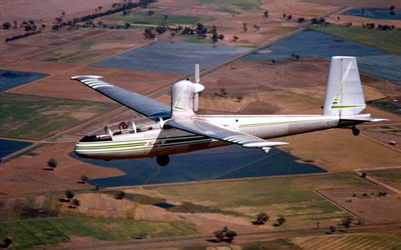
also remember the takeoff tests. Bill Riley was flying
the Motorblanik with an apprentice in the back seat
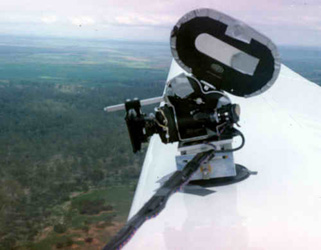
for ballast. Dafydd was on the cameras to record the
fifty foot height, Bert, as I recall was marking the
lift-off point. This usually requires some running
around, and Bert did that because Bill had hip
trouble. I was marking the start of roll and recording
temperature and wind. The take-off tests started at
first light, the temperature started at minus one and
finished at plus one. The anemometer turned about ten
times in total, giving a wind speed which amounted to
zero. All this was done before breakfast and it was a
real pleasure to go back to the Sportavia dining room
and thaw out.
I
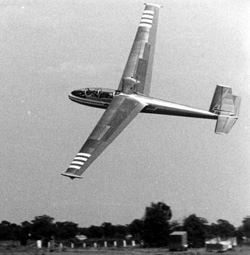
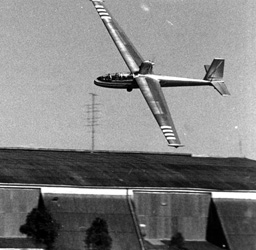
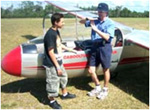
flew the Motorblanik on the third of May 1984, with
Herr Reinholdt in the back seat, performing eight
circuits in forty minutes including having the
instructor pull the power to simulate a rope break.
While the aircraft was still very noisy inside, it was
very comfortable to fly, though it did climb at a
lower speed, around 50 knots, than the aero tow speed
of 60 knots with the Citabria or Scout. This meant
getting the nose down a lot quicker than with a real
rope. The Motorblanik also came down rather more
quickly than the normal version with the engine
idling, the windmilling propeller giving a little more
that the equivalent of half airbrake. At idle, with
full brakes, the decent was similar in feel to an
early IS28 with upper and lower surface brakes.
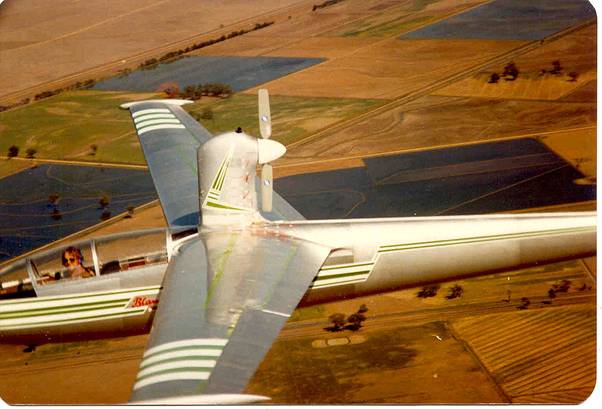
With
the mass of the engine and associated hardware up top,
the wing tended to drop quite heavily onto the ground
at the end of the landing roll, a bit like a Grob 103.
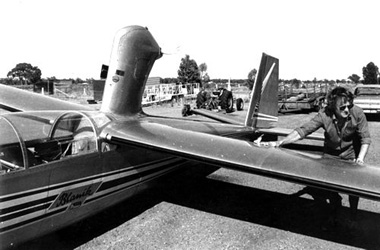
The Motorblanik had the ‘standard’ Riley
wingtip wheels and would therefore quite happily run
wing down for take off and landing. The original
steerable tail wheel was a menace, the combination of
top heavy airframe and castering of the tail wheel
causing the aircraft to perform a drunken
waddle. With a wing down it didn’t waddle, but it
wouldn’t run straight either. The steerable wheel
was replaced by a Riley fixed tail wheel. Turning was
done simply by pushing the stick forward and using the
rudder and wheel brake. There was a joke that the
Motorblanik was the only L13 in the world with the
wheel brake properly adjusted.
One
modification that wasn’t foreseen was the need for a
nose wheel. In the event that the aircraft stopped
with the main wheel against a grass tussock, opening
the throttle simply pitched the nose down until the
steel bumper hit the ground. It was found that the
aircraft would then not move, even at full power with
full back stick. The tail would come down hard,
regardless of elevator position when the power was
reduced, which wasn’t desirable. On sandy ground,
turning on the brake using forward stick and rudder
sometimes dug a hole the aircraft couldn’t get out
of. There were several push-backs during those days to
‘unstick’ the aircraft before Bert and Bill
devised and installed the nose wheel.
I
flew various normal Blaniks at various places over the
following years, including GUG at Caboolture in 1991.
It had been seventeen years since I last touched a
Blanik, when the Re-life project began on the
Bundaberg club aircraft, XQO, the first of the
‘new’ extended life Blaniks, where I had some very
minor involvement in the fuselage jig and cockpit
refurbishment. XQO has now returned to service.
The Motorblanik was a high point, in that I was
involved in something new and unique and, in return,
it gave me something I’d never had before. I learned
to land in it!
Bruce
Llewellyn. |